

Reusable Packing Market Forecast 2026-2036: Market to Reach USD 209.8 Billion by 2036 at 5.10% CAGR
Reusable Packing Market
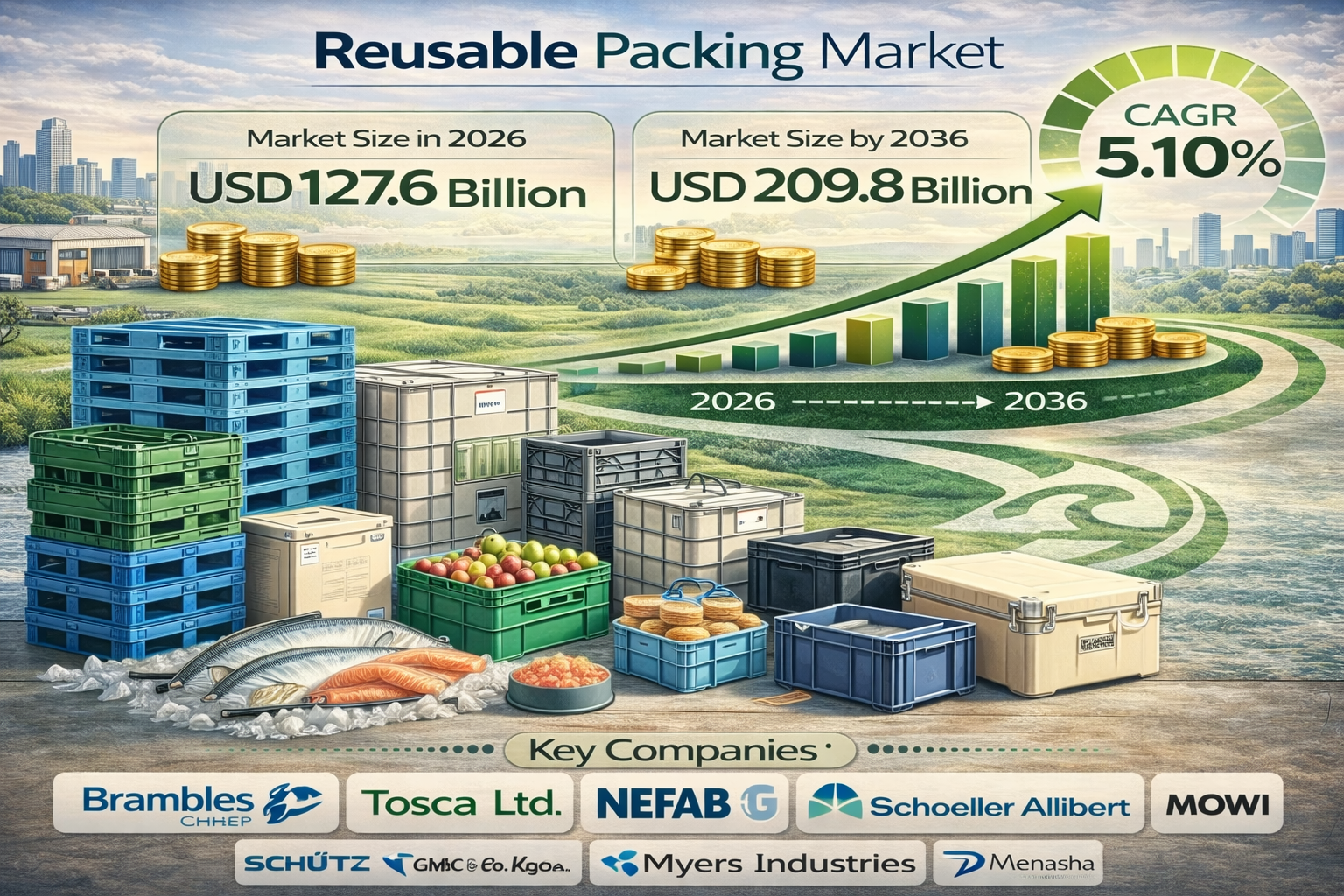
The reusable packing market is projected to cross USD 127.6 billion in 2026 and USD 209.8 billion by 2036, implying a 5.10% CAGR
NEW YORK, DE, UNITED STATES, March 2, 2026 /EINPresswire.com/ -- The Reusable Packing Market stood at USD 121.4 billion in 2025, is projected to cross USD 127.6 billion in 2026, and is forecast to reach USD 209.8 billion by 2036, advancing at a 5.10% CAGR. Growth momentum is directly linked to compliance gate pressures, extended producer responsibility (EPR) rollouts, and reverse-logistics optimization requirements.
Regulatory reprioritization toward circular waste management is redefining procurement criteria. Regulation (EU) 2025/40, enforced in January 2025, introduced strict empty-space ratio limits and reuse targets, accelerating fleet conversion toward trackable, audit-ready asset pooling networks across Europe and beyond.
• Market size in 2025 USD 121.4 billion
• Market size in 2036 USD 209.8 billion
• CAGR (2026–2036) 5.10%
• Leading material segment Plastic – 43.8%
• Leading end-use industry Food & Beverages – 29.7%
• Leading product type Pallets – 26.0%
• Key growth regions Asia growth corridors; regulated European markets; North America
• Top companies Brambles (CHEP); Tosca Ltd.; Nefab Group; Schoeller Allibert; Schütz GmbH & Co. KGaA; Myers Industries; Menasha Corporation
Market Momentum (YoY Path):
The Reusable Packing Market advances from USD 121.4 billion in 2025 to USD 127.6 billion in 2026, ultimately reaching USD 209.8 billion by 2036. Growth dispersion mirrors regulatory exposure and reverse-logistics infrastructure readiness.
Across key countries, CAGR projections include:
United States (5.4%), India (5.6%), China (5.3%), South Korea (5.2%), Japan (5.0%), United Kingdom (4.7%), and Germany (4.6%). Regions facing stricter penalties for single-use disposal are accelerating adoption of verifiable crate and pallet pooling systems.
Why the Market is Growing
The Reusable Packing Market is expanding as governments shift end-of-life costs to manufacturers under extended producer responsibility frameworks. Severe penalties for single-use transport packaging disposal are forcing operators into closed-loop networks with embedded tracking systems. Procurement teams prioritize RFID- or IoT-enabled containers that provide audit-ready lifecycle visibility. Compliance deadlines compress purchasing cycles, rewarding incumbents capable of offering integrated reverse logistics, wash hubs, and tracking software overlays.
Segment Spotlight
Plastic Leads with 43.8% Share
Plastic materials command 43.8% of market volume in 2026, driven by lightweight properties, sanitation resilience, and compatibility with repeated wash cycles. High-density polyethylene formats extend asset lifespan in harsh transit conditions. Mandated recycled content quotas further accelerate polymer formulation upgrades. Fleet managers increasingly favor blended polymers with verifiable post-consumer resin content to meet regulatory and ESG reporting requirements.
Food & Beverages Capture 29.7%
Food & Beverages account for 29.7% of total demand in 2026, reflecting strict contamination controls and cold-chain resilience requirements. Grocers depend on sanitized returnable crate fleets to protect perishables and minimize post-harvest losses. Auditable sanitation logs and temperature-monitoring integration narrow vendor shortlists. Regulatory bans on single-use wrappers for fresh items further push agricultural cooperatives toward rigid reusable container pools.
Pallets Anchor Structural Deployment at 26.0%
Pallets represent 26.0% of deployed product types in 2026, forming the base of automated material handling systems. Dimensional consistency is critical to prevent automated storage and retrieval system failures. Cross-border pest regulations restrict untreated timber platforms, accelerating migration toward synthetic, RFID-enabled structural bases. Leasing networks expand pan-regional pooling coverage, transitioning users from ownership to pay-per-trip models.
Get Access of Report Sample: https://www.futuremarketinsights.com/reports/sample/rep-gb-15498
Drivers, Opportunities, Trends, Challenges
• Drivers: Extended producer responsibility mandates fundamentally reshape asset ownership. Regulation (EU) 2025/40 and national EPR updates compel businesses to adopt durable, trackable transport packaging systems. Non-compliance penalties often exceed the cost of fleet conversion.
• Restraints: Reverse logistics complexity and asset tracking costs challenge smaller enterprises. Retrieving empty containers from decentralized retail nodes increases fuel consumption and coordination burdens. IoT sensor deployment mitigates shrinkage but raises unit costs.
• Opportunities: SaaS-based tracking integration reduces asset leakage and improves supply-chain efficiency. Localized waste conversion initiatives transform discarded polymers into heavy-duty transit items, lowering material acquisition costs. Decentralized wash hubs reduce empty-mile transport emissions.
• Trends: Capital shifts from static inventory ownership to dynamic pooling networks. RFID and IoT sensor adoption becomes standard as audit-readiness requirements intensify. Regional standardization initiatives, including Japan’s JIS X0560 RFID protocols, support automated scanning and compliance verification.
Competitive Landscape
The Reusable Packing Market remains moderately consolidated, shaped by established pooling operators and logistics specialists. Vendors without digital overlays experience severe asset attrition, pushing partnerships with SaaS providers. Brambles (CHEP) and Tosca Ltd. leverage global pooling scale and standardized container networks. Nefab Group, Schoeller Allibert, and Schütz GmbH & Co. KGaA emphasize durable formats integrated with tracking systems. Myers Industries and Menasha Corporation strengthen positions through manufacturing expertise and industrial sector reach. Compliance timelines dictate capital expenditure cycles, favoring vendors that bundle certified tracking software with physical transit assets.
FAQ:
What is the projected size of the Reusable Packing Market by 2036?
USD 209.8 billion.
What was the market size in 2025?
USD 121.4 billion.
What is the forecast CAGR from 2026 to 2036?
5.10%.
Which material leads the market?
Plastic with 43.8% share.
Which end-use industry dominates?
Food & Beverages at 29.7%.
Which product type is most deployed?
Pallets at 26.0%.
Why FMI: https://www.futuremarketinsights.com/why-fmi
Have a Look at Related Research Reports on the Packaging Domain:
Reusable Water Bottle Market: https://www.futuremarketinsights.com/reports/reusable-water-bottles-market
Wine Bag Market: https://www.futuremarketinsights.com/reports/wine-bags-market
Scented Insert Applicators Market: https://www.futuremarketinsights.com/reports/scented-insert-applicators-market
About Future Market Insights (FMI)
Future Market Insights, Inc. (FMI) is an ESOMAR-certified, ISO 9001:2015 market research and consulting organization, trusted by Fortune 500 clients and global enterprises. With operations in the U.S., UK, India, and Dubai, FMI provides data-backed insights and strategic intelligence across 30+ industries and 1200 markets worldwide.
Sudip Saha
Future Market Insights Inc.
+1 347-918-3531
email us here
Legal Disclaimer:
EIN Presswire provides this news content "as is" without warranty of any kind. We do not accept any responsibility or liability for the accuracy, content, images, videos, licenses, completeness, legality, or reliability of the information contained in this article. If you have any complaints or copyright issues related to this article, kindly contact the author above.
