

Global Vibration Control System Market to Reach USD 10.33 Billion by 2032 at 6.52% CAGR on AI Precision Demand
Vibration Control System Market graph
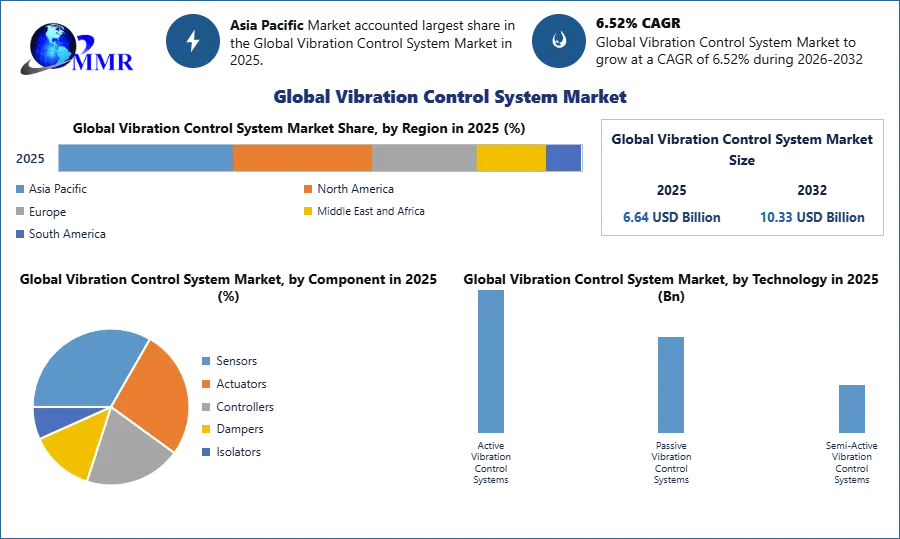
Vibration Control System Market was valued at USD 6.64 Billion in 2024 and is projected to reach nearly USD 10.33 Billion by 2032, growing at a 6.52% CAGR.
Maximize Market Research reveals that a fraction of a millimeter in vibration can now shatter multi-million dollar profit margins.”
ROCKVILLE , MD, UNITED STATES, March 2, 2026 /EINPresswire.com/ -- Propelled by strict operational mandates, the Vibration Control System Market is poised for aggressive growth. Originating from a USD 6.64 billion baseline in 2024, global industry revenues will compound at a 6.52% CAGR through the 2025 to 2032 forecast period, successfully culminating in a targeted USD 10.33 billion valuation.— Maximize Market Research
Get Full PDF Sample Copy of Report: (Including Full TOC, List of Tables & Figures, Chart) @ https://www.maximizemarketresearch.com/request-sample/104086/
The Nanoscale Lead: Redefining Stability in the Era of 2nm Fabrication
As the global manufacturing sector transitions into the sub-nanometer era, the margin for mechanical error has effectively vanished. In 2026, the "Zero-Failure" mandate is no longer a luxury but a baseline requirement for high-tech industries. Whether it is a semiconductor lithography machine where a single micrometer of floor vibration can ruin a US$ 100 million wafer batch, or surgical robotics requiring absolute precision, mechanical stability has become the ultimate currency of industrial ROI.
Maximize Market Research identifies a fundamental shift: vibration control is evolving from a "reactive component" to an "active digital asset." With the global market projected to reach USD 10.32 Billion by 2032, the focus has pivoted toward Smart Damping and Active-Passive Hybrid systems. These innovations utilize real-time AI to counteract oscillations before they compromise equipment integrity, ensuring operational resilience across the Asia-Pacific and North American high-tech corridors.
Tier 1: Active Isolation – Eliminating Sub-Micrometer Disruptions in Sub-2nm Fabrication
As semiconductor nodes shrink toward 2nm and below, the industry is witnessing a massive transition from passive mounts to Active Vibration Isolation (AVI). Unlike traditional dampers, active systems utilize a "proactive" architecture of piezoelectric actuators to counteract low-frequency floor vibrations in real-time.
A definitive 2026 benchmark for this technology is the global deployment of ASML’s High-NA (Numerical Aperture) EUV lithography systems. These US$ 380 million machines require a "Zero-Vibration" environment to position wafers with a precision of 60 picometers—smaller than a silicon atom. To achieve this, AVI systems utilize AI-driven feedback loops that adjust 20,000 times per second, canceling out tremors from nearby HVAC systems or transit infrastructure. This level of active stabilization is what enables the 6.52% CAGR as manufacturers pivot toward these sub-2nm nodes to power the next generation of AI processors.
Tier 2: Passive Damping – Engineering Structural Longevity for Heavy Industrial Assets
While active systems dominate cleanrooms, Passive Vibration Control remains the workhorse of global infrastructure. Utilizing advanced elastomeric materials and viscoelastic pads, these systems provide a cost-effective, fail-safe barrier against high-frequency structural noise.
In 2026, a primary driver for passive solutions is the Electric Vehicle (EV) battery housing sector. Real-world testing by firms like Valeo has demonstrated that "Vibration Fatigue" from random road roughness can compromise battery electrode separation, leading to thermal runaway. To mitigate this, manufacturers are integrating high-performance elastomeric mounts directly into the battery pack housing. These passive dampers are essential for meeting the 2026 EU Safety Directives, ensuring that high-voltage REESS (Rechargeable Energy Storage Systems) maintain structural integrity under continuous 28G longitudinal shocks without the need for external power sources.
Operational Dynamics: Mitigating the High Cost of Industrial Instability
The global push for vibration control is now a financial imperative. In 2026, the primary market driver is the escalating cost of "Micro-Vibration Failures," where the difference between profit and a multi-million dollar loss is measured in micrometers.
The "Wafer-Loss" Case Study: A definitive 2025-2026 benchmark is seen in Taiwan’s Advanced Fabrication Plants. Real-world data reveals that seismic events or structural resonances below 50 μm/s can trigger "Scrap Events" for 2nm wafers. During a 2025 tremor, fabs utilizing Predictive Active Isolation resumed operations in under 30 seconds, while legacy facilities faced over US$ 12 million in scrapped inventory and two days of diagnostic downtime.
This "Cost of Inaction" is driving the market toward USD 10.32 Billion by 2032. Beyond semiconductors, this dynamic is mirrored in Pharmaceuticals and Aerospace, where vibration-induced micro-cracks or crystallization failures lead to catastrophic regulatory risks. As industrial workforces prioritize Total Cost of Ownership (TCO), integrated vibration monitoring has shifted from an optional insurance policy to a core production requirement for maintaining 2026 competitive yield standards.
Key Recent Developments: Strategic Innovations in Precision Control
The 2025–2026 period is defined by technological leaps among leading industry players, bridging the gap between passive durability and active digital precision.
Technical Manufacturing Corp. (TMC): In January 2026, TMC introduced its next-generation piezoelectric active isolation architecture. Engineered specifically for sub-2nm semiconductor metrology, this system aggressively neutralizes low-frequency facility noise, directly improving high-resolution electron microscope yield rates in modern mega-fabs.
ContiTech AG: In November 2025, ContiTech launched a new series of bio-based elastomeric mounts optimized for heavy-duty Electric Vehicles (EVs). These advanced passive dampers withstand extreme thermal loads while shielding high-voltage battery enclosures from continuous chassis vibration, ensuring compliance with global ESG manufacturing mandates.
Crystal Instruments: In February 2026, Crystal Instruments integrated AI-driven predictive algorithms into its flagship vibration controllers. This critical advancement allows aerospace manufacturers to simulate extreme acoustic launch conditions for satellite payloads in real-time, reducing structural diagnostic times by nearly 20% while guaranteeing mission-critical compliance.
Get Full PDF Sample Copy of Report: (Including Full TOC, List of Tables & Figures, Chart) @ https://www.maximizemarketresearch.com/request-sample/104086/
Regional Industrial Hubs: The Geopolitics of Precision Manufacturing
The Asia-Pacific region commands the global vibration control market, anchored structurally by Taiwan’s expanding semiconductor corridors. As pure-play foundries scale their "advanced packaging" and silicon photonics footprints across seismically active zones, the integration of heavy-duty, hybrid vibration isolators has become a facility prerequisite. This rigorous "tectonic mitigation" ensures continuous high-yield production without referencing past disruptions, securing APAC’s leading revenue share.
Conversely, North American demand is accelerating through a commercial aerospace renaissance. Testing hubs across the U.S. Space Coast and Huntsville are investing heavily in massive thermal-vacuum and acoustic testing chambers. In these environments, multi-axis active controllers are mandated to simulate extreme orbital launch vibrations, guaranteeing satellite payload survivability before deployment.
This dual-engine geographic growth—micro-scale seismic stability in the East and macro-scale acoustic damping in the West—provides the structural foundation for the market's USD 10.32 Billion trajectory.
Key Market Players
Hutchinson
Dynatronic Corporation Ltd.
Cooper Standard
Crystal Instruments
Sentek Dynamics Inc.
Lord Corporation
Spektra Schwingungstechnik Und Akustik GmbH Dresden
Technical Manufacturing Corp.
Gerb Vibration Control Systems, Inc.
Müpro Services GmbH
ContiTech AG
Lord Corporation
Resistoflex (P) Ltd.
Fabreeka
VICODA GmbH
Market Segmentation: Analyzing High-Value Industrial Thresholds
To accurately map the industry's forthcoming expansion, the latest strategic analysis evaluates the global manufacturing landscape based on strict environmental tolerance thresholds rather than basic product categories. The segmentation framework highlights a critical pivot: the transition from legacy, single-axis Vibration Control to highly integrated, software-defined Motion Control architectures. Furthermore, the application analysis isolates revenue momentum based on the "cost of failure." While legacy sectors require macro-level structural durability, the highest compound annual growth is concentrated in low-tolerance environments, identifying high-value precision manufacturing, aerospace engineering, and advanced healthcare as the primary incubators for next-generation isolation technology.
By System Type
Motion Control
Vibration Control
By Application
Automotive
Aerospace & Defense
Manufacturing
Healthcare
Oil & Gas
Others
By Technology
Active Vibration Control Systems
Passive Vibration Control Systems
Semi-Active Vibration Control Systems
By Component
Sensors
Actuators
Controllers
Dampers
Isolators
By End-User Industry
Industrial
Commercial
Residential
Defense & Government
Get access to the full description of the report @ https://www.maximizemarketresearch.com/market-report/global-vibration-control-system-market/104086/
Analyst Perspective
The vibration control landscape is undergoing a paradigm shift from reactive structural damping to predictive, AI-integrated asset management, notes the lead analyst. In 2026, high-tech manufacturing cannot afford microscopic disruptions. Procurement strategies are now prioritizing total cost of ownership and yield protection over initial hardware costs. Systems equipped with real-time feedback loops are no longer optional for sub-2nm fabrication or aerospace testing; they are critical infrastructure. This pivot toward software-defined stability is the true catalyst driving long-term sector revenue.
FAQ’s
1: What is the projected market growth?
Ans: Valued at USD 6.23 Billion in 2024, it is forecast to reach USD 10.32 Billion by 2032 (6.52% CAGR).
2: Why are active systems gaining traction?
Ans: They use real-time AI to proactively neutralize sub-micrometer facility noise before it impacts production yields and diagnostic uptime.
3: How do electric vehicles impact vibration control?
Ans: Advanced passive elastomeric mounts are increasingly required to protect high-voltage EV battery enclosures from continuous chassis vibration.
4.How is this technology utilized in aerospace?
Ans: Multi-axis controllers simulate extreme acoustic launch vibrations to guarantee satellite payload survivability in thermal-vacuum chambers prior to deployment.
Related Reports
Vibration Monitoring Market: https://www.maximizemarketresearch.com/market-report/global-vibration-monitoring-market/55694/
Vibration Sensor Market: https://www.maximizemarketresearch.com/market-report/global-vibration-sensor-market/32109/
Vibration Level Switch Market: https://www.maximizemarketresearch.com/market-report/vibration-level-switch-market/16810/
Vibration Damper Market: https://www.maximizemarketresearch.com/market-report/global-vibration-damper-market/10859/
Top Reports:
Secondary Alkane Sulfonate Market size was valued at US$ 965.39 Mn. in 2022 and the total revenue is expected to grow at 6% through 2023 to 2029, reaching nearly US$ 1451.59 Mn. by 2029. https://www.maximizemarketresearch.com/market-report/global-secondary-alkane-sulfonate-market/97644/
The Scaffolding Market size was valued at USD 62.45 Billion in 2024 and the total Scaffolding revenue is expected to grow at a CAGR of 6.18% from 2025 to 2032, reaching nearly USD 100.90 Billion. https://www.maximizemarketresearch.com/market-report/scaffolding-market/22178/
Aesthetic Services Market is expected to reach US$ 3.59 Bn. at a CAGR of 10.65% during the forecast period 2030. https://www.maximizemarketresearch.com/market-report/global-aesthetic-services-market/92529/
Automotive Spur Gear Market is anticipated to reach US$ 43.01 Bn by 2029 from US$ 29.18 Bn in 2022 at a CAGR of 5.7% during a forecast period. https://www.maximizemarketresearch.com/market-report/global-automotive-spur-gear-market/101159/
Global Online Charging System market size was valued at USD 6.84 Bn. in 2024, and the Global Online Charging System Market revenue is expected to grow at a CAGR of 10.56% from 2025 to 2032, reaching nearly USD 15.27 Bn. https://www.maximizemarketresearch.com/market-report/online-charging-system-market/190411/
About Maximize Market Research
Maximize Market Research is a rapidly growing global business consulting firm. Our revenue-focused research initiatives proudly support many Fortune 500 companies across diverse sectors, including healthcare, aerospace, IT, and chemical manufacturing industries.
Domain Focus: Expertise in Electronics
Within the Electronics domain, our research assesses vibration control systems through nanoscale fabrication requirements and active isolation integration. We analyze damping technologies and operational economics shaping precision stability across global semiconductor manufacturing landscapes.
Lumawant Godage
MAXIMIZE MARKET RESEARCH PVT. LTD.
+ +91 96073 65656
email us here
Visit us on social media:
LinkedIn
Instagram
Facebook
X
Legal Disclaimer:
EIN Presswire provides this news content "as is" without warranty of any kind. We do not accept any responsibility or liability for the accuracy, content, images, videos, licenses, completeness, legality, or reliability of the information contained in this article. If you have any complaints or copyright issues related to this article, kindly contact the author above.
