

Modular Flooring Market Forecast 2026-2036: Market Value to Hit USD 82.4 Billion by 2036 Amid 5.2% CAGR
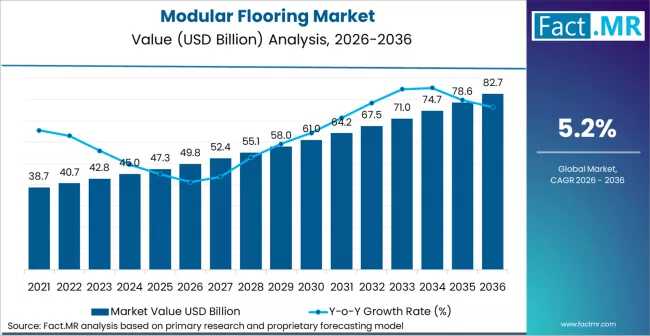
Modular Flooring Market
Carpet tiles lead the market with a 45% share, while resilient formats like LVT also see high adoption.
UNITED STATES, MD, UNITED STATES, March 2, 2026 /EINPresswire.com/ -- The global modular flooring market is estimated to reach a valuation of USD 49.8 billion in 2026. Driven by a shift toward design-led specification and lifecycle efficiency, the market is projected to expand to nearly USD 82.4 billion by 2036, registering a steady CAGR of 5.2% over the ten-year forecast period. This growth underscores a fundamental transition in commercial and residential interiors where modularity, ease of replacement, and sustainability are now primary procurement drivers.Get Access Report Sample : https://www.factmr.com/connectus/sample?flag=S&rep_id=14413
Modular Flooring Market Quick Stats
Market size 2026? The market is estimated at USD 49.8 billion.
Market size 2036? The market is projected to reach USD 82.4 billion.
CAGR? A compound annual growth rate of 5.2% is expected from 2026 to 2036.
Leading product segment(s) and shares? Carpet tiles lead the market with a 45% share, while resilient formats like LVT also see high adoption.
Leading material type and share? Prefabricated tiles and planks (Carpet, Vinyl, Laminate) dominate, with non-residential formats leading demand.
Leading end use and share? Non-residential applications account for 55% of the market share.
Key growth regions? Asia Pacific is the fastest-growing region, anchored by China and India.
Top companies? Mohawk Industries, Inc., Shaw Industries Group, Inc., Interface, Inc., Tarkett S.A., AHF Products, Forbo Flooring Systems, Milliken & Company, Gerflor Group, Beaulieu International Group, and LX Hausys.
Market Momentum (YoY Path)
The Modular Flooring Market is set to add approximately USD 33.0 billion in value over the forecast window. Starting at USD 49.8 billion in 2026, the market will climb to approximately USD 55.1 billion in 2028 and USD 61.1 billion by 2030. By 2031, the value is expected to reach USD 64.3 billion, continuing its steady ascent to USD 71.1 billion in 2033 and USD 78.7 billion in 2035, finally hitting the forecast peak of USD 82.4 billion in 2036. Early growth is fueled by carpet tile replacement in offices, while later years see a surge in specialty modular flooring for healthcare and industrial facilities.
Why the Market is Growing
The market is expanding as facility managers prioritize reducing downtime during renovations. Modular systems allow for selective replacement of individual tiles or planks without disrupting entire floor areas. Additionally, the rise in urban residential projects and the need for high-performance surfaces that meet slip resistance, acoustic control, and indoor safety requirements—particularly in healthcare and education—are significant catalysts for adoption.
Segment Spotlight
1) Product Type: Carpet Tiles (45% Share)
Carpet tiles currently hold a 45% share of the global Modular Flooring Market. This dominance is attributed to their superior acoustic performance and the ""selective replacement"" advantage they offer in commercial interiors. Facility managers favor this format to minimize operational downtime and manage noise in high-traffic workplace environments.
2) Material Type: Resilient & Vinyl Modules
The market is seeing a significant shift toward rigid and flexible LVT, as well as engineered wood modules. These materials are chosen for their dimensional stability and ease of installation. In healthcare and industrial sectors, performance validation and maintenance efficiency make these modular formats more attractive than traditional poured or roll-based systems.
3) End Use: Non-Residential (55% Share)
The non-residential sector accounts for 55% of the market demand. This is driven by frequent refurbishment cycles in offices, hospitals, and schools. Because these spaces require continuous operation, the ability to perform phased upgrades using modular systems is a critical factor in flooring selection.
Drivers, Opportunities, Trends, Challenges
Drivers: The primary driver is the shift toward rapid installation formats that support accelerated construction schedules and reduced labor costs. Regulatory frameworks, such as the U.S. OSHA walking-working surfaces standards, also push building owners toward modular products that meet specific hazard prevention and slip-resistance criteria.
Opportunities: Substantial opportunity exists in the Asia Pacific region, where commercial infrastructure development in China and India is booming. Manufacturers can capitalize on this by aligning product portfolios with specification-led refurbishment cycles rather than relying solely on new construction projects.
Trends: There is a notable transition from traditional sheet and broadloom products toward modular systems that offer reversible interior design and simplified maintenance. This trend is further supported by innovations in sustainable materials, such as bio-based backings and recycled content, which are becoming standard in design-led procurement.
Challenges: Conventional broadloom carpets and poured flooring remain widely used due to legacy supply chains and established cost familiarity. Furthermore, modular flooring often carries a pricing premium due to the precision manufacturing and engineered locking mechanisms required, which may impact volume growth in price-sensitive segments.
Country Growth Outlook (CAGR)
Country CAGR (2026-2036)
China 7.0%
India 6.5%
Germany 6.0%
France 5.5%
United Kingdom 4.9%
United States 4.4%
Brazil 3.9%
Competitive Landscape
The Modular Flooring Market is characterized by intense competition centered on validated durability and installation efficiency. Mohawk Industries, Inc. and Shaw Industries Group, Inc. lead the market with high-performance tiles tested for fire and wear resistance. Interface, Inc. and Tarkett S.A. differentiate through sustainability credentials, while AHF Products and Forbo Flooring Systems focus on dimensional stability. Other key players include Milliken & Company, Gerflor Group, Beaulieu International Group, and LX Hausys, all of whom emphasize multi-region compliance and acoustic performance to secure specifications in healthcare and education sectors.
To View Related Report
https://www.factmr.com/report/modular-construction-fasteners-market - Modular Construction Fasteners Market
https://www.factmr.com/report/modular-power-pods-market - Modular Power Pods Market
https://www.factmr.com/report/modular-robot-market - Modular Robot Market
https://www.factmr.com/report/modular-containers-market - Modular Containers Market
https://www.factmr.com/report/modular-hydrogen-pods-market - Modular Hydrogen Pods Market
https://www.factmr.com/report/modular-self-contained-aisle-and-racking-systems-market - Modular Self-Contained Aisle and Racking Systems Market https://www.factmr.com/report/modular-microfactories-market - Modular Microfactories Market
https://www.factmr.com/report/modular-cleanroom-solutions-market - Modular Cleanroom Solutions Market
https://www.factmr.com/report/modular-chiller-market - Modular Chiller Market
About Fact.MR
Fact.MR is a global market research and consulting firm, trusted by Fortune 500 companies and emerging businesses for reliable insights and strategic intelligence. With a presence across the
S. N. Jha
Fact.MR
+1 628-251-1583
email us here
Legal Disclaimer:
EIN Presswire provides this news content "as is" without warranty of any kind. We do not accept any responsibility or liability for the accuracy, content, images, videos, licenses, completeness, legality, or reliability of the information contained in this article. If you have any complaints or copyright issues related to this article, kindly contact the author above.
