

Millisecond-Switchable Flat Lens that Sees Depth and Detail on Demand
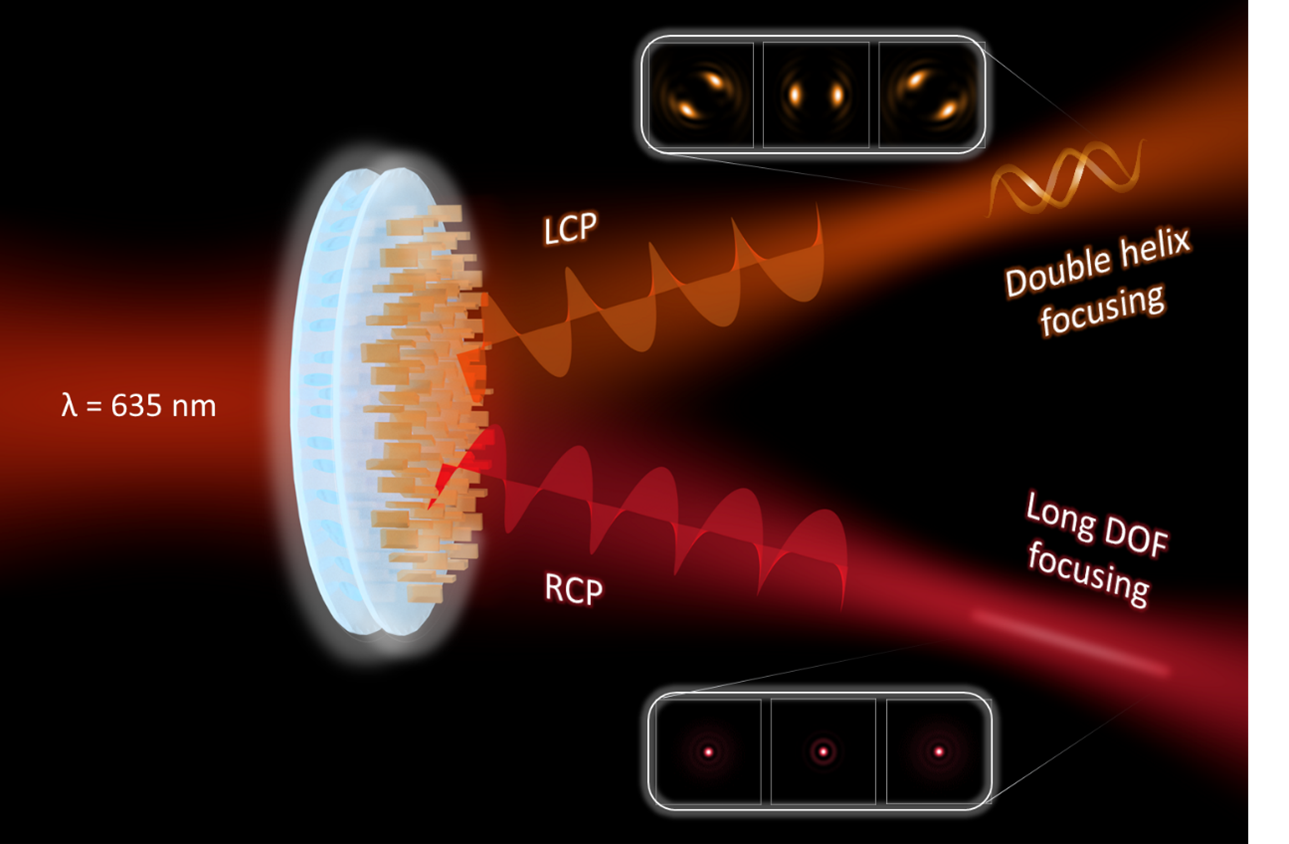
Figure 1. One metalens, two ways of seeing: depth-encoded (LCP) and high-detail (RCP)
SHANNON, CLARE, IRELAND, February 27, 2026 /EINPresswire.com/ -- Announcing new publication from Opto-Electronic Advances; DOI 10.29026/oea.2026.250216.
The authors of this article have built a paper-thin “metalens” that can change how it looks at the world with just a tiny electrical nudge. Instead of bulky curved glass, a metalens is a flat sheet covered with patterns much smaller than a human hair. These patterns steer light in clever ways. device flips between two useful views. In the first, the lens produces two small bright spots that rotate as the subject moves closer or farther away. The angle of rotation acts like a ruler, letting a computer read out depth directly from the image. In the second view, the lens keeps a wide slice of the scene in focus at the same time, so fine details stay sharp without constantly refocusing.
The switching is done electronically using a thin layer of liquid crystal—similar to what is used in displays. When a small voltage is applied, the crystal changes the “twist” (polarization) of the incoming light. One twist triggers the depth-sensing view; the other produces the extended-focus, high-detail image. The change happens in milliseconds, fast enough to alternate between the two views almost instantly. Because no parts move, the approach can be compact, stable, and energy-efficient.
Why is this helpful? Many real-world samples, especially biological tissues, are not flat. Leaves have veins and layers; muscle fibers weave in depth; tiny organisms wriggle while being observed. Conventional microscopes often force a trade-off—either narrow depth with high clarity, or broader depth with blur. They also rely on mechanical motion to scan through layers, which is slow and can smear fast changes. This metalens places depth information directly in the image, while also offering a mode that preserves crisp detail across a wider range. In demonstrations, the researchers measured the depth of features across roughly a hundred micrometers and generated color-coded maps that show where structures sit in three dimensions. They did this with a single metalens and small voltage control.
The device is made from tiny pillars of a silicon-based material arranged so that they shape light efficiently at red wavelengths. It fits easily into existing optical setups and requires only standard laboratory equipment. Beyond lab microscopes, the idea could shrink depth-sensing cameras, improve endoscopes, and enable handheld medical tools that switch tasks electronically. It also suggests a future where flat, programmable optics replace bulky stacks of glass, bringing powerful 3D vision to devices that must be light, fast, and portable. In short, the team shows that depth and detail can be delivered by the same flat lens, chosen on the fly by a flick of voltage.
The research group of Prof. Junsuk Rho from Pohang University of Science and Technology (POSTECH) introduces an electronically switchable flat lens that addresses a familiar bottleneck in imaging: the tension between seeing small features clearly and keeping more of the scene in focus. Traditional solutions rely on multiple lenses, moving stages, focusing motors, and heavy computation. While effective, these approaches increase size and complexity and can struggle with dynamic samples. The present work shows that a single, ultra-thin component can deliver both depth readout and sharp imaging by design, using only low-voltage electrical control.
At the heart of the advance is functional switching at the wavefront level. When the incident light’s polarization is set one way, the metalens forms two small foci whose rotation angle precisely tracks axial position. That angle is easy to measure and translate into depth, enabling 3D mapping without mechanical scanning. When the polarization is flipped, the same device produces a long, needle-like focus that preserves lateral sharpness across an extended range. Alternating between the two in milliseconds allows users to capture a depth-encoded frame and a high-detail frame nearly back-to-back, then combine them for quantitative, depth-colored images.
This capability speaks directly to needs in biology and medicine. Tissues are thick and heterogeneous; small organisms move; practical instruments must be compact and robust. The team demonstrates that their device retrieves depth over a range relevant to many specimens while maintaining detail sufficient for sub-cellular features. Because the control signal is electrical and the optics are flat, the approach lends itself to portable microscopes, minimally invasive probes, and point-of-care diagnostics. Outside the life sciences, compact depth-aware cameras could benefit machine vision, robotics, and augmented reality, where devices must be lightweight yet perceptive.
Equally important is manufacturability. The metalens is built from hydrogenated amorphous silicon pillars on glass using standard lithography and etching, processes compatible with semiconductor fabrication. The liquid-crystal layer introduces polarization control without bulky mechanics and operates at modest voltages. Together they form a platform that is scalable, material-agnostic, and adaptable across wavelengths. The authors also outline practical paths to further improvement—larger apertures for wider fields of view, antireflection coatings for higher throughput, and faster, GPU-based processing for real-time depth rendering.
In sum, this work translates sophisticated light control into a simple user experience: decide whether the priority is depth or detail, send a small voltage, and the same flat lens complies. It is a clear step toward compact optical engines that reconfigure on demand, bringing 3D awareness and sharp vision to instruments that must be small, fast, and reliable.
Keywords: chiral-dependent 3D imaging retrieval, chiral-dependent 3D imaging, spin dependent, electrically tunable, metasurface
# # # # # #
Prof. Junsuk Rho’s Photonics Lab at POSTECH explores flat optics and nanophotonics from fundamentals to deployable systems. The group studies deep sub-wavelength light–matter interactions and translates that knowledge into devices such as reconfigurable metasurfaces, ultra-sensitive biosensors, nanoscale lasers, next-generation near-eye displays, radiative-cooling elements, unconventional nanofabrication methods, scalable nanomanufacturing, and data-driven inverse design. Their workflow is end-to-end: electromagnetic theory, numerical design, cleanroom fabrication, optical characterization, and system integration.
Prof. Rho holds endowed chair professorships at POSTECH and maintains appointments across Mechanical, Chemical, and Electrical Engineering. He earned his Ph.D. at the University of California, Berkeley, followed by research at Lawrence Berkeley National Laboratory and a principal-investigator role at Argonne National Laboratory. He and his collaborators have authored several hundred papers across leading journals, and the lab maintains active partnerships with academic and industrial teams worldwide.
Guided by the vision of compressing complex optical benches into thin, manufacturable components, the group aims to deliver compact, fast, and intelligent photonic systems. Their recent work on an electrically switchable metalens exemplifies this mission: by uniting flat optics with voltage control, they demonstrate how a single chip can provide both depth sensing and high-resolution imaging, pointing toward future instruments that are smaller, cheaper, and more capable.
# # # # # #
Opto-Electronic Advances (OEA) is a high-impact, open access, peer reviewed SCI journal with an impact factor of 22.4 (Journal Citation Reports 2024). OEA has been indexed in SCI, EI, DOAJ, Scopus, CA and ICI databases, and expanded its Editorial Board to 41 members from 17 countries.
# # # # # #
More information: http://www.oejournal.org/oea
Editorial Board: http://www.oejournal.org/oea/editorialboard/list
All issues available in the online archive (http://www.oejournal.org/oea/archive).
Submissions to OEA may be made using ScholarOne (https://mc03.manuscriptcentral.com/oea).
ISSN: 2096-4579
CN: 51-1781/TN
Contact Us: oea@ioe.ac.cn
Twitter: @OptoElectronAdv (https://twitter.com/OptoElectronAdv?lang=en)
WeChat: OE_Journal
# # # # # #
Kim Y, Lee J, Kim WS et al. Millisecond-level electrically switchable metalens for adaptive rotational depth mapping and diffraction-limited imaging. Opto-Electron Adv 9, 250216 (2026). DOI: 10.29026/oea.2026.250216
Opto-Electronic Advances Editorial Office
Opto-Electronic Advances
+86 591 2286 1222
email us here
Legal Disclaimer:
EIN Presswire provides this news content "as is" without warranty of any kind. We do not accept any responsibility or liability for the accuracy, content, images, videos, licenses, completeness, legality, or reliability of the information contained in this article. If you have any complaints or copyright issues related to this article, kindly contact the author above.
