

Smart Label Market Outlook 2026–2036: Global Industry to Reach USD 39.2 Billion by 2036 at 11.0% CAGR
Smart Label Market
USA smart label demand is growing at a 10.5% CAGR, driven by RFID/NFC adoption for tracking, compliance, and secure, automated supply chain operations.
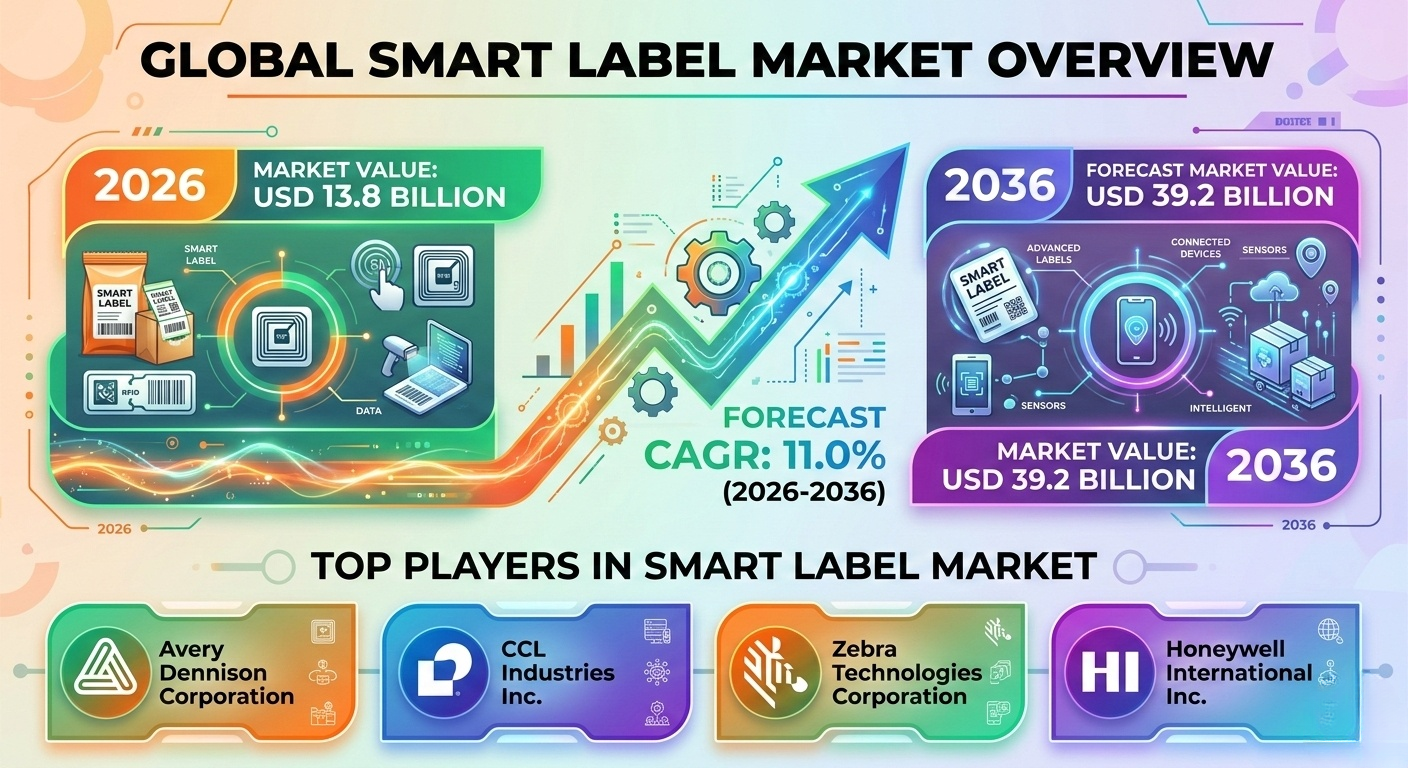
NEWARK, DE, UNITED STATES, February 27, 2026 /EINPresswire.com/ -- The global smart label market is entering a phase of accelerated expansion, driven by increasing adoption of digital labeling technologies across supply chains, retail networks, and regulated industries. Valued at USD 13.8 billion in 2026, the market is projected to reach USD 39.2 billion by 2036, registering a compound annual growth rate (CAGR) of 11.0% during the forecast period.
The growth reflects a structural shift toward intelligent identification systems that enable real-time tracking, product authentication, and enhanced visibility across complex logistics ecosystems. Organizations across sectors are integrating smart labels to improve operational efficiency, ensure compliance, and support data-driven decision-making.
Key Market Highlights
• Market Value (2026): USD 13.8 billion
• Forecast Value (2036): USD 39.2 billion
• CAGR (2026–2036): 11.0%
• Leading Technology Segment: RFID Labels (52% share in 2026)
• Leading End Use Segment: Retail & E-commerce (38% share in 2026)
• High-Growth Regions: China, India, South Korea
Explore Opportunities – Get Your Sample of Our Industry Overview Now!
https://www.futuremarketinsights.com/reports/sample/rep-gb-2704
Market Overview: What Is Driving Smart Label Adoption?
Smart labels integrate technologies such as RFID, NFC, and sensing capabilities to enable automated data capture and seamless interaction between physical products and digital systems. These labels are increasingly deployed across inventory management, asset tracking, product authentication, and consumer engagement applications.
The market expansion is supported by the growing need for traceability and transparency across supply chains. Companies are adopting smart labels to monitor product movement, verify authenticity, and capture real-time information on product condition and lifecycle. These capabilities are becoming critical in industries that require precise monitoring, including healthcare, food, logistics, and manufacturing.
Why the Smart Label Market Is Expanding
The increasing adoption of automated inventory systems and digital tracking technologies is a primary driver of market growth. Retailers and logistics providers are implementing smart labels to reduce manual processes, improve stock accuracy, and enable real-time inventory visibility.
In the food and beverage sector, smart labels support traceability and regulatory compliance by providing detailed information about product origin, handling, and storage conditions. Pharmaceutical companies are leveraging these technologies to combat counterfeiting, ensure product integrity, and maintain visibility across distribution networks.
Technology Insights: RFID Labels Lead Market Growth
RFID labels represent the dominant technology segment, accounting for approximately 52% of the market in 2026. Their widespread adoption is driven by their ability to enable real-time identification, automated scanning, and high-volume data capture across retail and logistics operations.
UHF RFID technology is gaining traction due to its extended read range, faster scanning capabilities, and improved performance in warehouse and point-of-sale environments. These features support large-scale tracking and automated inventory systems.
End-Use Analysis: Retail and E-commerce Dominate
Retail and e-commerce represent the largest end-use segment, accounting for 38% of market demand in 2026. The sector relies on smart labels to manage high inventory volumes, improve traceability, and support efficient stock replenishment across omnichannel platforms.
Smart labels enable automated checkout, reduce shrinkage, and provide consumers with interactive product information. As organized retail and online marketplaces continue to expand, demand for intelligent labeling solutions is expected to remain strong.
Regional Outlook: Asia Leads Global Expansion
The smart label market demonstrates strong geographic diversification, with Asia emerging as a key growth hub.
• China leads with a CAGR of 13.2%, driven by large-scale manufacturing and export operations.
• India follows with a CAGR of 12.8%, supported by increasing digitization in retail and logistics.
• South Korea records 11.5% growth, backed by advanced electronics and semiconductor industries.
Developed markets such as the United States, Germany, Japan, and the United Kingdom continue to adopt smart labeling technologies to enhance compliance, automation, and supply chain security.
Key Drivers Shaping the Market
• Rising demand for automated inventory visibility and supply chain traceability
• Increasing adoption of IoT-based tracking systems
• Growth of connected packaging and digital supply chain platforms
• Expansion of retail, e-commerce, and logistics networks
• Advancements in RFID, NFC, and sensor-enabled labeling technologies
Market Challenges and Constraints
Despite strong growth prospects, the market faces several challenges. High infrastructure costs associated with RFID readers, sensors, and backend systems remain a barrier to adoption, particularly for small and medium enterprises.
Standardization issues across RFID frequencies create interoperability challenges in multi-region deployments. Integration with enterprise systems such as ERP and warehouse management platforms requires technical alignment, increasing implementation complexity.
Regulatory variations across regions and ongoing maintenance requirements for sensor-enabled labels further contribute to operational costs and compliance burdens.
Emerging Trends in Smart Label Technology
The market is witnessing rapid innovation in sensor-enabled smart labels capable of monitoring temperature, humidity, and tampering. These capabilities are particularly relevant for cold chain logistics and pharmaceutical supply chains.
Cloud-based data platforms are increasingly used to process and analyze large volumes of data generated by smart labels. Chip miniaturization is enabling more compact and flexible label designs, expanding applications across high-value and space-constrained products.
Manufacturers are also focusing on developing intelligent labels that offer improved durability, scalability, and integration with digital ecosystems.
Competitive Landscape
The smart label market is moderately consolidated, with leading players focusing on technological innovation, production scale, and system integration capabilities. Companies are investing in advanced RFID inlays, sensor-enabled labels, and secure authentication technologies to meet evolving industry requirements.
Key Companies
• Avery Dennison Corporation
• CCL Industries Inc.
• Zebra Technologies Corporation
• Honeywell International Inc.
• Sato Holdings Corporation
• Alien Technology Corporation
• Checkpoint Systems
• Smartrac Technology GmbH
• Thin Film Electronics ASA
• Intermec
Competitive differentiation is increasingly driven by the ability to deliver integrated solutions combining hardware, software, and cloud-based data management platforms.
Why FMI: https://www.futuremarketinsights.com/why-fmi
Have a Look at Related Research Reports on the Packaging Domain:
Release Tapes Market https://www.futuremarketinsights.com/reports/release-tapes-market
Low Density Polyethylene Packaging Market https://www.futuremarketinsights.com/reports/low-density-polyethylene-packaging-market
Electronic Shelf Label Market https://www.futuremarketinsights.com/reports/electronic-shelf-label-market
About Future Market Insights (FMI)
Future Market Insights, Inc. (FMI) is an ESOMAR-certified, ISO 9001:2015 market research and consulting organization, trusted by Fortune 500 clients and global enterprises. With operations in the U.S., UK, India, and Dubai, FMI provides data-backed insights and strategic intelligence across 30+ industries and 1200 markets
Sudip Saha
Future Market Insights Inc.
+1 347-918-3531
email us here
Legal Disclaimer:
EIN Presswire provides this news content "as is" without warranty of any kind. We do not accept any responsibility or liability for the accuracy, content, images, videos, licenses, completeness, legality, or reliability of the information contained in this article. If you have any complaints or copyright issues related to this article, kindly contact the author above.
